

Emma Hanegraef
Emma holds a MSc in Cellular and Genetic Engineering and has been passionate about the science behind skincare and health since the age of 12. As an experienced formulator, she translates complex scientific concepts into accessible knowledge, helping you make informed choices about your formulas.
Astaxanthin is the strongest antioxidant found in nature, and the science behind it is now deep. Researchers have run more than 3,500 studies on this red carotenoid, including dozens of human clinical trials. That evidence answers the questions people ask most: what it does, how much to take, and how to tell a strong product from a weak one.
This guide gives you 20 clear answers, each backed by named studies. You get the direct answer first, then the proof. Every claim links to the research in the reference list at the end, so you can check it yourself.
Astaxanthin comes from the microalgae Haematococcus pluvialis. The algae build it to survive intense light and stress, and the same molecule protects human cells from oxidative damage. Below you will find what the clinical trials show for skin, eyes, heart, brain, immune health, exercise, and women's health, plus practical guidance on dose, timing, and quality.
Astaxanthin and antioxidant power
1. What is astaxanthin?
Astaxanthin is a red-orange carotenoid and the most powerful antioxidant known in nature. It gives salmon, shrimp, and flamingos their color, and it protects living cells from free radicals. Its structure lets it work across the entire cell membrane, inside and outside, which most antioxidants cannot do [1,2]. To go deeper, read our guide on what astaxanthin is and where it comes from.
2. Why is astaxanthin the most powerful antioxidant?
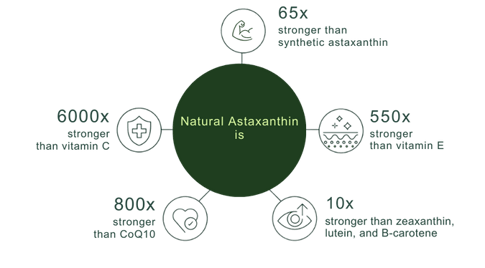
Astaxanthin out-performs every common dietary antioxidant in lab tests of free-radical control. In a benchmark study by Nishida and colleagues, it quenched singlet oxygen 6,000 times more effectively than vitamin C, 800 times more than coenzyme Q10, 550 times more than vitamin E, and 75 times more than alpha-lipoic acid [1]. It also neutralizes free radicals without turning into a damaging pro-oxidant, a weakness seen in some other antioxidants [2]. Read the full case for astaxanthin as the most powerful antioxidant.
3. How is astaxanthin different from vitamin C, vitamin E, and CoQ10?
Astaxanthin spans the whole cell membrane, while vitamin C works only in water and vitamin E only in fat. This dual position lets it protect both sides of the membrane at once [2]. It also crosses the blood-brain and blood-retina barriers, so it reaches the brain and eyes directly [11,20]. On raw antioxidant strength it beats all three in head-to-head lab tests [1].
4. What is the difference between natural and synthetic astaxanthin?
Natural astaxanthin from Haematococcus pluvialis is far stronger than the synthetic form. Independent lab testing found natural astaxanthin over 50 times more powerful than synthetic astaxanthin at quenching singlet oxygen, and about 20 times stronger at eliminating free radicals [3]. Natural astaxanthin exists as a single molecular form (3S,3'S) bonded to fatty acids. Synthetic astaxanthin is made from petrochemicals as a mix of three forms and is used mainly to color farmed fish [3]. See how production shapes quality in our astaxanthin production story.
5. Where does astaxanthin come from?
The richest natural source is the microalgae Haematococcus pluvialis, which stores astaxanthin at up to 5% of its dry weight [4]. Salmon, trout, shrimp, krill, and lobster carry it too, but only because they eat algae lower in the food chain. Food gives you small amounts, so a serving of salmon provides only a few milligrams. Krill oil contains even less, roughly 250 to 500 micrograms per serving, far below the studied dose.
Astaxanthin health benefits, backed by clinical trials
6. What are the main benefits of astaxanthin?
Human trials show clear results for skin, eyes, cardiovascular markers, immune function, and exercise recovery, all driven by its antioxidant action. Astaxanthin improves skin elasticity and moisture [5,6], reduces eye fatigue [9], lowers cholesterol and oxidative stress markers [12,16], and strengthens immune response [16]. The sections below give you the study details for each one.
7. Does astaxanthin improve skin?
Yes. Randomized controlled trials show astaxanthin improves skin elasticity, moisture, and wrinkle depth. In a study of 49 healthy women, 6 mg per day for 8 weeks significantly improved wrinkle parameters, elasticity, and moisture, and reduced age-spot size [6]. A separate trial in 36 men found the same 6 mg dose improved crow's-feet wrinkles and elasticity in 6 weeks [5]. Combined with collagen, astaxanthin also raised skin elasticity and lowered the collagen-degrading enzyme MMP-1 [7]. See our full breakdown of astaxanthin for skin.
8. Does astaxanthin protect skin against UV damage?
Yes. In a randomized, double-blind, placebo-controlled trial, astaxanthin raised the skin's minimal erythema dose, meaning the skin resisted UV-induced redness better, and it reduced moisture loss after UV exposure [8]. Astaxanthin works from inside the skin by lowering UV-driven oxidative stress. It does not replace sunscreen, since it does not block or reflect UV rays. Use it alongside broad-spectrum SPF.
9. Does astaxanthin make you tan?
No. Astaxanthin does not make you tan. A tan comes from melanin, and astaxanthin does not trigger melanin production. What it does is protect skin cells from the oxidative stress that UV light creates, which helps your skin handle sun exposure and defends collagen against UV damage [8]. Any small change in glow is not a true tan.
10. Does astaxanthin reduce eye fatigue?
Yes. Multiple controlled trials show astaxanthin relieves eye strain from screens. In visual display terminal workers, 6 mg per day for 4 weeks significantly improved the eye's ability to focus (accommodation) compared with placebo [9]. Astaxanthin reaches the ciliary muscle that controls focus and increases retinal blood flow [10]. This is why it is one of the most studied ingredients for screen-related eye fatigue, with more than 60 human trials on eye health.
11. Does astaxanthin support brain health?
Yes. Astaxanthin crosses the blood-brain barrier, so it protects brain tissue directly [20]. In a randomized, double-blind, placebo-controlled trial, adults with age-related forgetfulness took 6 or 12 mg per day for 12 weeks and showed significant gains in cognitive test scores versus placebo [11]. The brain is rich in fat and uses large amounts of oxygen, which makes astaxanthin's fat-soluble, membrane-spanning protection a strong fit [20].
12. Does astaxanthin support heart health?
Yes. Astaxanthin improves several cardiovascular markers in human trials. In a 24-week randomized controlled trial in people with prediabetes and dyslipidaemia, astaxanthin lowered LDL cholesterol and other cardiovascular risk markers [12]. Earlier work showed astaxanthin protects LDL cholesterol from oxidation in a dose-dependent way, a key step in keeping arteries healthy [13,14]. These effects trace back to its antioxidant and anti-inflammatory action.
13. Does astaxanthin improve exercise performance and recovery?
Yes. Astaxanthin supports endurance and recovery in trained people. A randomized trial in competitive cyclists found astaxanthin improved 20 km time-trial performance [15]. A 2024 meta-analysis of nine controlled trials confirmed astaxanthin improved cycling time-trial performance and raised total antioxidant capacity in athletes [14,15]. It also protects immune proteins that normally drop after hard exercise, which supports faster recovery [16].
14. Does astaxanthin strengthen the immune system?
Yes. In a randomized, double-blind, placebo-controlled trial, astaxanthin raised immune activity and lowered markers of inflammation and DNA damage. Participants taking astaxanthin for 8 weeks showed increased natural killer cell activity and T-cell response, a drop in the DNA-damage marker, and lower C-reactive protein, a marker of inflammation [16]. These results came at doses of 2 to 8 mg per day.
15. What are the benefits of astaxanthin for women's health?
Astaxanthin offers women strong support for skin aging and antioxidant balance. The main skin trials were run in women: 6 mg per day for 8 weeks improved wrinkles, elasticity, moisture, and age spots in 49 healthy women [6]. In postmenopausal women, astaxanthin supplementation reduced lipid peroxidation and improved antioxidant status, a period when oxidative stress tends to rise [17]. Its immune and cardiovascular benefits, shown in trials that included women, add further value across the lifespan [12,16].
How to take astaxanthin
16. How much astaxanthin should you take per day?
Most human trials use 4 to 12 mg per day, and this range delivers the benefits described above. Skin and eye results appear at 6 mg per day [5,6,9]. Heart and cognitive trials used 12 mg per day [11,12]. The European Food Safety Authority set an acceptable daily intake of 0.2 mg per kilogram of body weight, about 12 mg for a 60 kg adult, and astaxanthin from H. pluvialis holds GRAS status in the United States [19].
17. When and how should you take astaxanthin?
Take astaxanthin with a meal that contains fat. Astaxanthin is fat-soluble, and a lipid-based formula raised its absorption in humans by about 3.7 times compared with taking it alone [18]. The time of day does not matter, so choose a meal you eat consistently, such as breakfast or lunch. Daily use matters more than timing, because astaxanthin builds up in your tissues over weeks.
18. How long does astaxanthin take to work?
It depends on the goal, and the trials give clear timelines. Eye-fatigue benefits appear in 2 to 4 weeks [9]. Skin improvements in elasticity and moisture show at 6 to 8 weeks [5,6]. Cognitive and cardiovascular trials ran 12 weeks or longer [11,12]. Astaxanthin accumulates in tissue gradually, so take it daily and give it several weeks before you judge the effect.
19. Is astaxanthin safe, and are there side effects?
Astaxanthin has an excellent safety record. It holds GRAS status in the United States, the European Food Safety Authority has confirmed its safety as a supplement, and dozens of human trials report it as well tolerated at 4 to 12 mg per day [19]. Reported side effects are limited to occasional mild digestive changes. One practical note: astaxanthin has mild blood-thinning activity, so if you take anticoagulant medication, speak with your doctor first. For a fuller breakdown, see our guide on astaxanthin side effects and safety.
20. What should you look for when buying astaxanthin?
Choose natural astaxanthin from Haematococcus pluvialis, not synthetic, since the natural form is over 50 times stronger as an antioxidant [3]. Check for a clear dose in milligrams, a fat or oil carrier for absorption, and clean, solvent-free extraction. A dedicated astaxanthin supplement beats krill oil, which carries only trace amounts. axabio® produces its natural astaxanthin in patented fourth-generation flat-panel photobioreactors, extracts it with solvent-free supercritical CO2, and delivers the purest and most stable natural astaxanthin in the world. In 2026, axabio® became the first natural astaxanthin producer to earn certified B Corporation status.
The bottom line on astaxanthin
Astaxanthin is the most powerful antioxidant nature produces, and human trials back that strength with real results. It improves skin elasticity and wrinkles, relieves screen-related eye fatigue, lowers cardiovascular risk markers, sharpens cognitive scores, strengthens immune response, and supports women's skin and antioxidant health. A natural product at 4 to 12 mg per day, taken with food, delivers these benefits safely. Quality depends on the source, so choose natural astaxanthin from Haematococcus pluvialis with clean extraction.
Want the purest and most stable natural astaxanthin in the world? Explore axabio®s production technology and product range, and contact our scientific team to talk through your formulation.

References
- Nishida Y, Yamashita E, Miki W. Quenching activities of common hydrophilic and lipophilic antioxidants against singlet oxygen using chemiluminescence detection system. Carotenoid Science. 2007;11:16-20.
- Miki W. Biological functions and activities of animal carotenoids. Pure and Applied Chemistry. 1991;63(1):141-146.
- Capelli B, Bagchi D, Cysewski GR. Synthetic astaxanthin is significantly inferior to algal-based astaxanthin as an antioxidant and may not be suitable as a human nutraceutical supplement. NutraFoods. 2013;12:145-152.
- Lorenz RT, Cysewski GR. Commercial potential for Haematococcus microalgae as a natural source of astaxanthin. Trends in Biotechnology. 2000;18(4):160-167.
- Tominaga K, Hongo N, Karato M, Yamashita E. Cosmetic benefits of astaxanthin on human subjects. Acta Biochimica Polonica. 2012;59(1):43-47.
- Tominaga K, Hongo N, Fujishita M, Takahashi Y, Adachi Y. Protective effects of astaxanthin on skin deterioration. Journal of Clinical Biochemistry and Nutrition. 2017;61(1):33-39.
- Yoon HS, Cho HH, Cho S, Lee SR, Shin MH, Chung JH. Supplementing with dietary astaxanthin combined with collagen hydrolysate improves facial elasticity and decreases matrix metalloproteinase-1 and -12 expression: a comparative study with placebo. Journal of Medicinal Food. 2014;17(7):810-816.
- Ito N, Seki S, Ueda F. The protective role of astaxanthin for UV-induced skin deterioration in healthy people: a randomized, double-blind, placebo-controlled trial. Nutrients. 2018;10(7):817.
- Nagaki Y, Hayasaka S, Yamada T, et al. Effects of astaxanthin on accommodation, critical flicker fusion, and pattern visual evoked potential in visual display terminal workers. Journal of Traditional Medicines. 2002;19(5):170-173.
- Nagaki Y, Mihara M, Takahashi J, et al. The effect of astaxanthin on retinal capillary blood flow in normal volunteers. Journal of Clinical Therapeutics and Medicines. 2005;21(5):537-542.
- Katagiri M, Satoh A, Tsuji S, Shirasawa T. Effects of astaxanthin-rich Haematococcus pluvialis extract on cognitive function: a randomised, double-blind, placebo-controlled study. Journal of Clinical Biochemistry and Nutrition. 2012;51(2):102-107.
- Ciaraldi TP, Boeder SC, Mudaliar SR, et al. Astaxanthin, a natural antioxidant, lowers cholesterol and markers of cardiovascular risk in individuals with prediabetes and dyslipidaemia. Diabetes, Obesity and Metabolism. 2023;25(7):1985-1994.
- Iwamoto T, Hosoda K, Hirano R, et al. Inhibition of low-density lipoprotein oxidation by astaxanthin. Journal of Atherosclerosis and Thrombosis. 2000;7(4):216-222.
- Fassett RG, Coombes JS. Astaxanthin: a potential therapeutic agent in cardiovascular disease. Marine Drugs. 2011;9(3):447-465.
- Earnest CP, Lupo M, White KM, Church TS. Effect of astaxanthin on cycling time trial performance. International Journal of Sports Medicine. 2011;32(11):882-888.
- Park JS, Chyun JH, Kim YK, Line LL, Chew BP. Astaxanthin decreased oxidative stress and inflammation and enhanced immune response in humans. Nutrition and Metabolism. 2010;7:18.
- Kim YK, Chyun JH. The effects of astaxanthin supplements on lipid peroxidation and antioxidant status in postmenopausal women. Nutritional Sciences. 2004;7(1):41-46.
- Mercke Odeberg J, Lignell A, Pettersson A, Höglund P. Oral bioavailability of the antioxidant astaxanthin in humans is enhanced by incorporation of lipid based formulations. European Journal of Pharmaceutical Sciences. 2003;19(4):299-304.
- EFSA Panel on Nutrition, Novel Foods and Food Allergens. Safety of astaxanthin for its use as a novel food in food supplements. EFSA Journal. 2020;18(2):5993.
- Grimmig B, Kim SH, Nash K, Bickford PC, Shytle RD. Neuroprotective mechanisms of astaxanthin: a potential therapeutic role in preserving cognitive function in age and neurodegeneration. GeroScience. 2017;39(1):19-32.
This article is for general information and does not replace medical advice. Speak with a qualified healthcare professional before starting any supplement, especially if you are pregnant, breastfeeding, taking medication, or managing a health condition.