
Emma Hanegraef
Emma holds a MSc in Cellular and Genetic Engineering and has been passionate about the science behind skincare and health since the age of 12. As an experienced formulator, she translates complex scientific concepts into accessible knowledge, helping you make informed choices about your formulas.
Open almost any astaxanthin softgel and you will find the same second ingredient: MCT oil. The label usually says it is there "for absorption." That explanation is close to right, but it skips the part that matters.
Astaxanthin cannot be absorbed without fat. That much is settled. Whether MCT oil specifically absorbs better than other oils is a separate question, and the research answer is more interesting than the marketing one.
This article covers what MCT oil is, why formulators reach for it, how it compares to olive, sunflower, soybean, fish and coconut oil, and what the human and animal data actually show about absorption. New to the molecule? Start with our overview of what astaxanthin is and where it comes from, then come back for the formulation detail.
Why is astaxanthin mixed with MCT oil?
Astaxanthin is mixed with MCT oil because astaxanthin is fat-soluble and needs dietary fat to be absorbed at all. MCT oil dissolves it well, resists oxidation, has no taste, and behaves the same way in every batch. It guarantees fat is present with the dose, which is the part that drives absorption.
That last sentence is the whole mechanism. The oil is not a booster. It is the vehicle.
Astaxanthin is fat-soluble, and that changes everything
Astaxanthin is a xanthophyll carotenoid. It does not dissolve in water. In a dry capsule it sits as crystals, and crystals cannot cross your intestinal wall.
Here is what has to happen instead:
- Fat in your gut triggers bile release.
- Bile salts and fatty acids form mixed micelles, tiny carrier particles.
- Astaxanthin dissolves into those micelles.
- Intestinal cells take up the micelle contents.
- The astaxanthin is packaged into chylomicrons and enters the lymph, then the blood.
Remove step one and the chain stops. This is why oral bioavailability of astaxanthin is low, commonly cited in the range of 10 to 50% of the dose depending on the format.
The clearest human evidence comes from a 2003 pharmacokinetic study published in the European Journal of Pharmaceutical Sciences. Healthy male volunteers took a single 40 mg dose of astaxanthin either as a lipid-based formulation or as a standard commercial supplement made of algae and dextrin in a hard capsule. The three lipid formulations reached 1.7 to 3.7 times the bioavailability of the reference. The elimination half-life was about 16 hours.
A later study on Haematococcus pluvialis extract found the same pattern with meals rather than formulations. Absorption was higher when astaxanthin was taken after eating than on an empty stomach.
Two conclusions follow, and they are not the same conclusion:
- Astaxanthin needs fat. This is robust and repeated across human and animal work.
- Which fat is best is still open. That is the question most product pages skip.
Your digestive system is doing real work here. If you want the wider picture on how astaxanthin interacts with the gut, see our review of astaxanthin and gut health.
What is MCT oil?
MCT stands for medium-chain triglyceride. These are fats whose fatty acid chains are 6 to 12 carbons long, shorter than the 16 and 18 carbon chains that dominate most dietary oils.
Commercial MCT oil is usually fractionated from coconut oil, sometimes from palm kernel oil. The fractionation strips out the longer chains and leaves mainly two fatty acids:
- C8, caprylic acid
- C10, capric acid
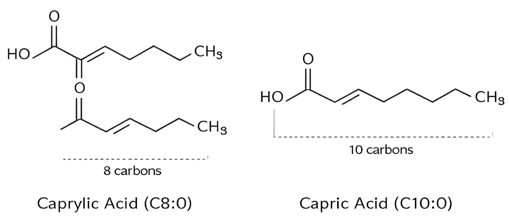
The result is a clear, thin, odourless liquid that stays liquid at room temperature and has a defined composition on every certificate of analysis.
MCTs are also metabolised differently from long-chain fats. They are hydrolysed fast, do not depend on bile salts or pancreatic enzymes to the same degree, and pass directly into the portal vein to the liver. Long-chain fats take the slower route through chylomicrons and the lymphatic system.
That difference is where a common misunderstanding starts. MCT's fast portal route applies to the MCT itself. Astaxanthin does not travel that way. Astaxanthin still needs micelles and chylomicrons, the long-chain route. So the speed of MCT metabolism tells you nothing useful about astaxanthin uptake.
Why formulators use MCT oil for astaxanthin
MCT oil earns its place for five reasons, and only one of them is absorption.
It dissolves carotenoids well. Astaxanthin oleoresin blends into MCT cleanly at typical loading levels and stays in solution. Crystallisation or separation in a softgel fill is a real failure mode, and MCT reduces the risk.
It resists oxidation. MCT fatty acids are fully saturated. No double bonds means nothing for oxygen to attack. Astaxanthin itself is an antioxidant and will sacrifice itself protecting an oxidising carrier oil, so a stable carrier directly protects your assay over shelf life. A 2021 study in LWT that tested MCT against soybean, sunflower, palm and cottonseed oil as carotenoid carriers measured a low peroxide value generation rate for MCT across 56 days of storage.
It has no taste or smell. Fish oil and olive oil bring flavour and odour. In a gummy, a chewable or an oil drop, that matters. Our axagums™ work only because the base is neutral.
It formulates consistently. MCT has a narrow, specified fatty acid profile batch after batch. Seed oils vary with harvest, region and refining. Viscosity, density and fill weight stay predictable, which keeps your dose accurate.
It is well documented. MCT has decades of use in clinical nutrition, enteral feeding and pharmaceutical lipid systems. Regulatory files are straightforward, and it is available in organic, non-GMO, kosher and halal grades.
MCT vs other carrier oils for astaxanthin
Here is how the common options compare for astaxanthin formulation.
| Carrier oil | Main fatty acids | Oxidative stability | Taste and odour | Digestibility | Fit for astaxanthin |
|---|---|---|---|---|---|
| MCT (C8/C10) | Saturated, medium chain | High, no double bonds | Neutral | Fast, low bile dependence | Strong. Stable, neutral, consistent |
| Olive oil | Oleic acid, monounsaturated | Moderate | Distinct, can be peppery | Standard long-chain route | Good on absorption data, weaker on flavour and consistency |
| Sunflower oil | Linoleic acid, up to about 61% polyunsaturated | Low | Mild | Standard long-chain route | Poor. Oxidises fast, chosen mainly on price |
| Soybean oil | Linoleic acid, high polyunsaturated | Low | Mild, can turn beany | Standard long-chain route | Poor. Same oxidation problem, allergen questions |
| Fish oil | EPA and DHA, highly polyunsaturated | Lowest | Strong, prone to rancid notes | Standard long-chain route | Weak as a carrier. Best kept as a separate active |
| Safflower Oil | Linoleic acid, up to about 75% polyunsaturated (standard); high-oleic variant roughly 75% monounsaturated | Low (standard); Moderate (high-oleic) | Mild | Standard long-chain route | Weak in standard form due to very high PUFA. High-oleic variant used by some producers as a standardisation carrier for oleoresin. Acceptable on stability but less neutral than MCT |
| Coconut oil | Lauric acid C12 plus long chains | High | Coconut note | Slower than MCT | Limited. Solid below roughly 24°C, hard to fill consistently |
Three notes on the table:
-
Polyunsaturated oils are the real problem. A fatty acid with two double bonds can oxidise 10 to 40 times faster than one with a single double bond. Sunflower and soybean oil sit at roughly 58 to 61% polyunsaturated fat. Putting an oxidation-sensitive carotenoid into an oxidation-prone oil works against you on shelf life.
-
Fish oil deserves a separate warning. Beyond oxidation and flavour, patent literature reports that astaxanthin blended directly into krill oil becomes difficult to recover by HPLC, pointing to a chemical interaction between the two. If you want astaxanthin and omega-3 in one product, keep them as separate ingredients rather than using the omega-3 as the carrier. We covered why that pairing is worth making in our article on astaxanthin and omega-3 for brain health.
- Safflower is worth separating into two products. Standard safflower oil is the highest-PUFA option in the table and oxidises fast. High-oleic safflower oil, bred to replace most of that linoleic acid with oleic, is a different story. At roughly 75% oleic it is moderately stable, neutral in flavour and has been used commercially as the blending oil for Haematococcus pluvialis oleoresin by at least one major supplier. Its main limitation compared with MCT is that its fatty acid profile can vary with crop and refiner, which makes batch-to-batch consistency harder to guarantee.
-
Coconut oil is not MCT oil. Coconut oil contains a large share of lauric acid, C12, which behaves more like a long-chain fat, plus enough longer chains to make it solid at room temperature. MCT oil is the fraction taken out of it.
Does MCT oil actually increase astaxanthin absorption?
This is where careful reading matters, so here is the honest version.
Astaxanthin absorbs better with fat than without it. That is established.
MCT specifically beating other oils is not established. Some evidence points the other way.
A 2021 study in the Journal of the Science of Food and Agriculture tested astaxanthin esters in different oil matrices using a simulated digestion model and a mouse study. Bioaccessibility and bioavailability rose as fatty acid chain length rose, with triglyceride oleate ahead of triglyceride caprylate, which is MCT. They also rose as unsaturation fell, with olive oil ahead of corn oil, which was ahead of fish oil. Micelle size was the main factor behind the differences.
Read plainly: in that model, olive oil and other long-chain oils outperformed MCT on absorption. A 2025 study on bile salt micelle formation reported a similar direction, with higher bioaccessibility from a flaxseed oil nanoemulsion than from an MCT nanoemulsion.
The picture is not one-sided. A 2006 study found that an astaxanthin ester built with n-octanoic acid, a medium chain, absorbed more effectively than the long-chain ester found naturally in Haematococcus pluvialis. Chain length effects depend on whether you are looking at the carrier oil or at the fatty acids esterified to the astaxanthin molecule itself.
So the accurate claim is this. MCT oil guarantees that fat is present with the dose, which is what drives absorption. It is not proven to absorb better than long-chain oils, and in some models it absorbs slightly less. It is chosen because it holds up over shelf life, tastes of nothing, and behaves the same every batch.
Any brand telling you MCT dramatically increases astaxanthin absorption is ahead of the evidence. Formulation quality, dose and the astaxanthin itself matter more than the carrier.
How to take astaxanthin for the best absorption
The practical guidance is short.
- Take it with a meal that contains fat. Any fat works. Olive oil, avocado, eggs, oily fish, nuts. This is the single biggest variable you control.
- Oil-filled softgels remove the guesswork. The fat is already in the capsule, so absorption does not depend on what you ate.
- Time of day does not matter much. No trial has shown morning beats evening. Consistency matters more. Most people find it easiest to attach it to their largest meal.
- Give it 8 weeks. Astaxanthin accumulates in tissue. Human trials that found effects on inflammation and lipids generally ran 12 weeks or longer. See the timelines in our review of astaxanthin and cholesterol.
- Avoid dry powder formats taken on an empty stomach. That is the closest thing to the low-absorption reference arm in the 2003 study.
If you prefer to get astaxanthin from your plate, the same rule applies. Cook salmon, trout or shrimp with fat rather than steaming them dry. Our list of the best astaxanthin-rich foods has the full range.
Why axabio® uses MCT oil
MCT oil from coconut sits at the centre of how we formulate and standardise across the axabio® range. axapure™ 5 and axapure™ 10, our 5% and 10% natural astaxanthin oleoresins, are both standardised in MCT oil. That means MCT is the blending oil used to dilute the concentrated CO₂ extract to its labelled astaxanthin percentage. It is the best option for this job: it dissolves astaxanthin cleanly at every concentration, generates almost no peroxides and has a fixed, narrow fatty acid profile that does not move between batches the way a seed oil would. Any carrier oil that oxidised during blending or storage would degrade the astaxanthin it surrounds, so using MCT here is a decision about protecting the molecule before it ever reaches the customer.
In the finished formats, axagels™ and axacaps™ take that same axapure™ 10 oleoresin, add D-α-tocopherol (natural vitamin E) for an additional antioxidant layer, then encapsulate in vegan, carrageenan-free shells in Belgium. axagums™ use the same axapure™ 10 oleoresin base, combined with pectin, natural polyols and vitamin E in a vegan, sugar-free gummy , also made in Belgium. All three start with MCT-standardised oleoresin. That full-chain choice maps onto the four things we build every product around.
Stability. MCT is fully saturated and generates peroxides slowly. Paired with D-α-tocopherol, it protects the astaxanthin rather than competing with it for antioxidant capacity. Our starting material already carries a strong cis/trans isomer profile and monoester to diester ratio, and the carrier is chosen to keep it that way through shelf life.
Bioavailability. The astaxanthin is dissolved in oil at the moment of encapsulation, so there is no crystal to dissolve in your gut. The fat needed for micelle formation arrives with the dose. That removes the variable that costs most consumers most of their absorption.
Purity. Fractionated MCT is a defined, neutral ingredient with no solvent residues and no allergen baggage. Upstream, we extract with supercritical CO₂, which is solvent-free, and our heavy metals sit consistently below detection limits.
Consistent manufacturing. MCT arrives on spec every time. Combined with astaxanthin grown in patented 4th-generation flat-panel photobioreactors under AI-controlled light in Hemiksem, Belgium, rather than in open outdoor ponds, the result is a product that measures the same batch after batch. If you are comparing suppliers, our technology-based comparison of astaxanthin producers sets out how the production methods differ.
What to check on an astaxanthin label
- Is there an oil at all? A dry capsule with no fat is the weakest format.
- Which oil? Sunflower and soybean signal a cost decision. MCT, olive or algae oil signal a stability decision.
- Is there vitamin E or another antioxidant? It protects the carrier and the astaxanthin.
- Astaxanthin dose or oleoresin weight? 100 mg of a 5% oleoresin is 5 mg of astaxanthin. Many labels blur the two.
- Natural or synthetic? Only natural astaxanthin from Haematococcus pluvialis carries the clinical evidence. We explain why in natural vs. synthetic astaxanthin.
The Bottom Line
Astaxanthin is mixed with MCT oil because it has to be mixed with something fatty, and MCT is the most reliable option available. It dissolves carotenoids well, resists oxidation, tastes of nothing and arrives on spec every batch.
What it does not do is beat other oils on absorption. The comparative data slightly favour long-chain oils such as olive oil for uptake, and the honest position is that the carrier's main job is guaranteeing fat is present, not accelerating anything.
Take astaxanthin with fat. Take it consistently. Then judge the product on the astaxanthin itself: natural, from Haematococcus pluvialis, produced under controlled conditions, dosed clearly on the label.
If you formulate supplements and want a natural astaxanthin with the stability data behind it, see the axabio® ingredient range or talk to our team about your carrier system.

References
- Mercke Odeberg J, Lignell Å, Pettersson A, Höglund P. Oral bioavailability of the antioxidant astaxanthin in humans is enhanced by incorporation of lipid based formulations. European Journal of Pharmaceutical Sciences. 2003;19(4):299–304. doi:10.1016/S0928-0987(03)00135-0
- Yang C, Zhang H, Liu R, et al. Influence of oil matrixes on stability, antioxidant activity, bioaccessibility and bioavailability of astaxanthin ester. Journal of the Science of Food and Agriculture. 2021;101(8):3550–3560. doi:10.1002/jsfa.10780
- Okada Y, Ishikura M, Maoka T. Bioavailability of astaxanthin in Haematococcus algal extract: the effects of timing of diet and smoking habits. Bioscience, Biotechnology, and Biochemistry. 2009;73(9):1928–1932. doi:10.1271/bbb.90078
- Zhang X, Wang X, Liu Y, et al. Carotenoid-enriched oil preparation and stability analysis during storage: influence of oils' chain length and fatty acid saturation. LWT. 2021;152:112314. doi:10.1016/j.lwt.2021.112314
- Fukami H, Namikawa K, Sugiura-Tomimori N, et al. Chemical synthesis of astaxanthin n-octanoic acid monoester and diester and evaluation of their oral absorbability. Journal of Oleo Science. 2006;55(12):653–656. doi:10.5650/jos.55.653
- Zhu Q, Liu X, Pan W, Chen X, Zuo Y, Liu X, Xu Y, McClements DJ, Liu C. Fatty acid unsaturation regulates astaxanthin encapsulation in bile salt micelles: insights into self-assembly mechanisms and molecular interactions. Journal of Colloid and Interface Science. 2026;703:139057. doi:10.1016/j.jcis.2025.138720 (published online September 2025)
- Symoniuk E, Ratusz K, Krygier K. Comparison of the oxidative stability of soybean and sunflower oils enriched with herbal plant extracts. Chemical Papers. 2018;72:2607–2615. PMC6096694
- Zhu J, Xiao Y, Deng Y, et al. Food-grade nanostructured delivery systems for oral administration of astaxanthin: bioprocessing strategies and therapeutic applications. npj Science of Food. 2025;9:4. doi:10.1038/s41538-025-00653-y
- You YQ, Ling PR, Qu JZ, Bistrian BR. Effects of medium-chain triglycerides, long-chain triglycerides, or 2-monododecanoin on fatty acid composition in the portal vein, intestinal lymph, and systemic circulation in rats. JPEN Journal of Parenteral and Enteral Nutrition. 2008;32(2):169–175. doi:10.1177/0148607108314758
- Kozłowska M, Gruczyńska E. Changes in fatty acid composition and oxidative stability of soybean and sunflower oils. (as cited in: Hu X, Luo Y, et al. Vegetable oil oxidation: mechanisms, impacts on quality, and approaches to enhance shelf life. Food Chemistry X. 2025. doi:10.1016/j.fochx.2025.102388*)