

Emma Hanegraef
Emma holds a MSc in Cellular and Genetic Engineering and has been passionate about the science behind skincare and health since the age of 12. As an experienced formulator, she translates complex scientific concepts into accessible knowledge, helping you make informed choices about your formulas.
You sleep eight hours and still wake up tired. Stairs feel harder than they did five years ago. Recovery after a workout takes days instead of hours. Many things can cause this, and one of them sits inside almost every cell you have.
Mitochondrial health describes how well your mitochondria turn food and oxygen into usable energy. When they work well, your cells have the fuel they need. When they slow down, cells run short, and the tissues that use the most energy notice first.
This guide explains what mitochondria do and what happens when your cells run low on energy. You will learn why mitochondria change with age, how oxidative stress builds up, and which daily habits support them. You will also see what research says about astaxanthin, the red carotenoid from the microalgae Haematococcus pluvialis.
Key takeaways
- Mitochondria make ATP, the energy molecule every cell runs on.
- Your brain, heart and muscles hold the most mitochondria.
- With age, mitochondria make less ATP and more free radicals.
- Exercise, sleep and a colourful diet support mitochondrial health.
- Astaxanthin protected mitochondria from oxidative stress in lab studies.
What Are Mitochondria and What Do They Do?
Mitochondria are small structures inside your cells that produce most of your body's energy. They take sugars and fats from your food and combine them with the oxygen you breathe. The result is a molecule called ATP, short for adenosine triphosphate.
ATP powers everything you do. Every muscle contraction, nerve signal and repair job inside a cell uses it. Your body makes and recycles roughly its own weight in ATP every day, yet it only stores a few seconds' worth¹. That is why your mitochondria never stop working.
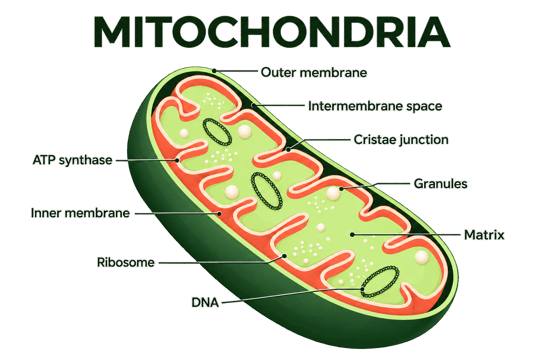
Where your mitochondria are concentrated
Cells that need more energy hold more mitochondria. A skin cell has relatively few. A heart muscle cell contains thousands, and they fill a large share of its volume.
- Your brain makes up about 2% of your body weight but uses about 20% of your resting energy².
- Your heart beats around 100,000 times a day without a pause.
- Your skeletal muscles can raise their energy use many times over during exercise.
- Your liver and kidneys filter and process substances around the clock.
More than energy production
Mitochondria also manage calcium levels inside the cell. They send signals that tell a cell when to repair itself. They also start the controlled removal of cells that are too damaged to keep.
Mitochondria even carry their own small set of DNA. You inherit it from your mother only.
What Happens When Your Cells Run Low on Energy?
When mitochondria cannot keep up with demand, the cell has to prioritise. It keeps essential tasks running and cuts back on repair, maintenance and extra output. Scientists call a lasting version of this mitochondrial dysfunction.
You feel it first in the tissues with the highest energy needs.
- Your muscles tire sooner, and recovery after exercise takes longer.
- Your brain struggles to concentrate, especially late in the day.
- Your heart has less reserve when you push yourself physically.
- Your metabolism burns fat less efficiently, and cells respond less well to insulin.
Low cellular energy is rarely the only reason someone feels tired. Poor sleep, low iron, thyroid problems and many other conditions also cause fatigue. If tiredness lasts for weeks, talk to your doctor.
Cellular energy and fat burning
Mitochondria are also where your body burns fat for fuel. Fatty acids enter the mitochondria and break down step by step into ATP. When mitochondria slow down, fat burning slows too. You can read more about this process in our article on astaxanthin and fat metabolism.
Mitochondria and Ageing: Why Your Cells Slow Down
Mitochondria and ageing are closely linked. Researchers list mitochondrial dysfunction among the hallmarks of ageing³. These are the core biological changes found in ageing tissues across species.
Several changes build up over the years.
- Older muscle tends to hold fewer mitochondria, and each one works less efficiently.
- Each mitochondrion makes less ATP from the same amount of fuel.
- Ageing mitochondria release more free radicals as by-products.
- Mitochondrial DNA sits close to where free radicals form, so damage to it builds up over time.
- Mitophagy, the system that removes broken mitochondria, slows down. Damaged mitochondria stay in the cell longer.
A 2014 review in Longevity & Healthspan describes mitochondria as both the main source of free radicals and their main target⁴. That is why research on mitochondria and ageing keeps returning to one subject: oxidative stress.
Ageing does not follow a fixed path
The pace of these changes varies a lot between people. In a Mayo Clinic study, 12 weeks of high-intensity interval training improved mitochondrial function in younger and older adults⁵. The training also reversed many age-related differences in mitochondrial proteins. Your daily habits shape how your mitochondria age.
Oxidative Stress and Mitochondrial Damage
Every time mitochondria make ATP, a small share of the oxygen they use turns into reactive oxygen species. Most people call them free radicals. These unstable molecules steal electrons from fats, proteins and DNA.
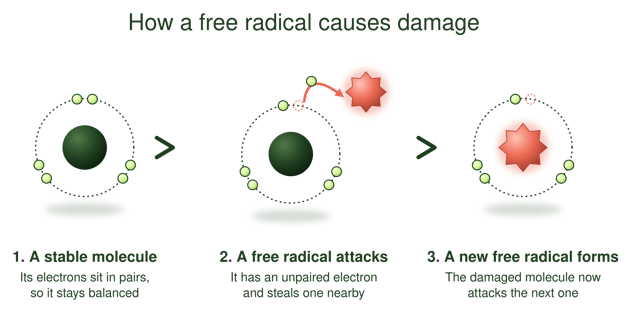
Small amounts are normal and even useful. Your body uses them as signals, for example to start adapting after exercise. Your cells also make their own antioxidants, such as superoxide dismutase and glutathione, to keep levels in check.
Oxidative stress begins when free radicals outpace these defences. To learn how free radicals form and which compounds neutralise them, read our guide to the most powerful antioxidant.
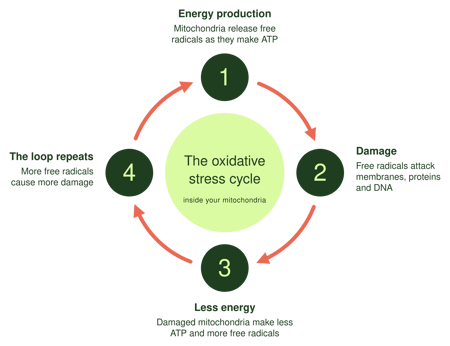
How oxidative stress becomes a cycle
- Mitochondria produce free radicals as they make ATP.
- Free radicals damage the mitochondrial membrane, proteins and DNA.
- Damaged mitochondria make less ATP and release more free radicals.
- More free radicals cause more damage, and the cycle repeats.
A 2025 review on mitochondria, oxidative stress and ageing describes this as a vicious cycle⁶. Inflammation adds to it. Damaged mitochondria release signals that trigger inflammation, and inflammation produces more free radicals.
Why the mitochondrial membrane matters
The inner mitochondrial membrane is where ATP is made. It is rich in fats, and these fats are easy targets for free radicals. A damaged membrane leaks, and the cell loses the electrical charge it needs to make ATP.
Under severe stress, a channel in this membrane opens fully. Scientists call it the permeability transition pore. Once it opens, the mitochondrion swells and the cell can die. Protecting this membrane is central to mitochondrial health.
This also explains why some antioxidants matter more for mitochondria than others. A compound that stays in the watery parts of the cell cannot reach the fats in the membrane. To protect mitochondria, an antioxidant needs to work where the damage happens.
What adds to oxidative stress
- Chronic psychological stress
- Smoking and air pollution
- Too much alcohol
- Diets high in refined sugar and low in plants
- Short or broken sleep
- Long periods of sitting
- Intense UV exposure
Stress deserves extra attention, because it raises cortisol and free radical levels at the same time. Our article on astaxanthin and stress explains this link in detail.
How to Support Mitochondrial Health Every Day
No single product fixes mitochondria. The strongest evidence for mitochondrial health points to habits you already know, done consistently. Each one either builds new mitochondria, protects the ones you have, or helps your cells clear out damaged ones.
Move every day and push a little
Exercise is the most proven way to build new mitochondria, a process called mitochondrial biogenesis. Endurance and interval training both work. Strength training keeps your muscle mass, and muscle holds a large share of your mitochondria.
- Aim for at least 150 minutes of moderate activity per week⁷.
- Add one or two short interval sessions if your health allows.
- Include strength training twice a week.
Sleep seven to nine hours
Your cells carry out much of their repair work during sleep. Short sleep raises oxidative stress and leaves less time for cleanup. Keep a regular bedtime and wake time, even at weekends.
Eat for your mitochondria
Mitochondria need nutrients to run. B vitamins, iron, magnesium and coenzyme Q10 all play a role in making ATP. Colourful plants add antioxidants such as polyphenols and carotenoids.
- Fill half your plate with vegetables and fruit, including berries.
- Eat legumes, nuts and whole grains most days.
- Include oily fish such as wild salmon for omega-3 fats and natural astaxanthin.
- Limit refined sugar, ultra-processed foods and alcohol.
For a full list with the science behind each one, see our guide to longevity foods.
Manage stress
Chronic stress keeps cortisol high and adds to oxidative stress over time. Short breaks during the day, time outdoors and slow breathing all lower your stress response. Social contact helps too.
Daily habits for mitochondrial health at a glance
|
Habit |
What it does for your mitochondria |
|---|---|
|
Interval and endurance training |
Triggers the growth of new mitochondria |
|
Strength training |
Keeps the muscle mass that holds most of your mitochondria |
|
Seven to nine hours of sleep |
Gives cells time to repair and clear damaged mitochondria |
|
Colourful plant foods |
Supply antioxidants that limit oxidative stress |
|
Oily fish |
Provides omega-3 fats and natural astaxanthin for cell membranes |
|
Stress management |
Lowers cortisol and the free radicals that come with it |
Common Mitochondrial Health Mistakes to Avoid
Good intentions do not always help your mitochondria. These are the mistakes we see most often.
Relying on caffeine and sugar for energy
Coffee and sweet snacks make you feel more alert, but they do not raise your cells' ability to produce ATP. Large sugar swings also add to oxidative stress. Use them as extras, not as your energy plan.
Training hard without recovery
Exercise builds mitochondria, but only when your body has time to adapt. Hard sessions every day with short sleep keep free radical levels high. Plan at least one or two easy days per week.
Taking megadoses of antioxidants around workouts
Free radicals from exercise act as a signal for your muscles to adapt. Very high doses of vitamin C and vitamin E taken during a training period can blunt that signal⁸. Steady, moderate antioxidant intake from food and well-dosed supplements is a better approach.
Expecting results in days
Mitochondrial health changes slowly. Most training studies measure changes after 8 to 12 weeks. Pick habits you can keep for months, not a short challenge.
Ignoring product quality
An antioxidant supplement that has broken down on the shelf gives you little benefit. This matters most for sensitive molecules such as astaxanthin, which we cover next.
Where Astaxanthin Fits in Mitochondrial Health
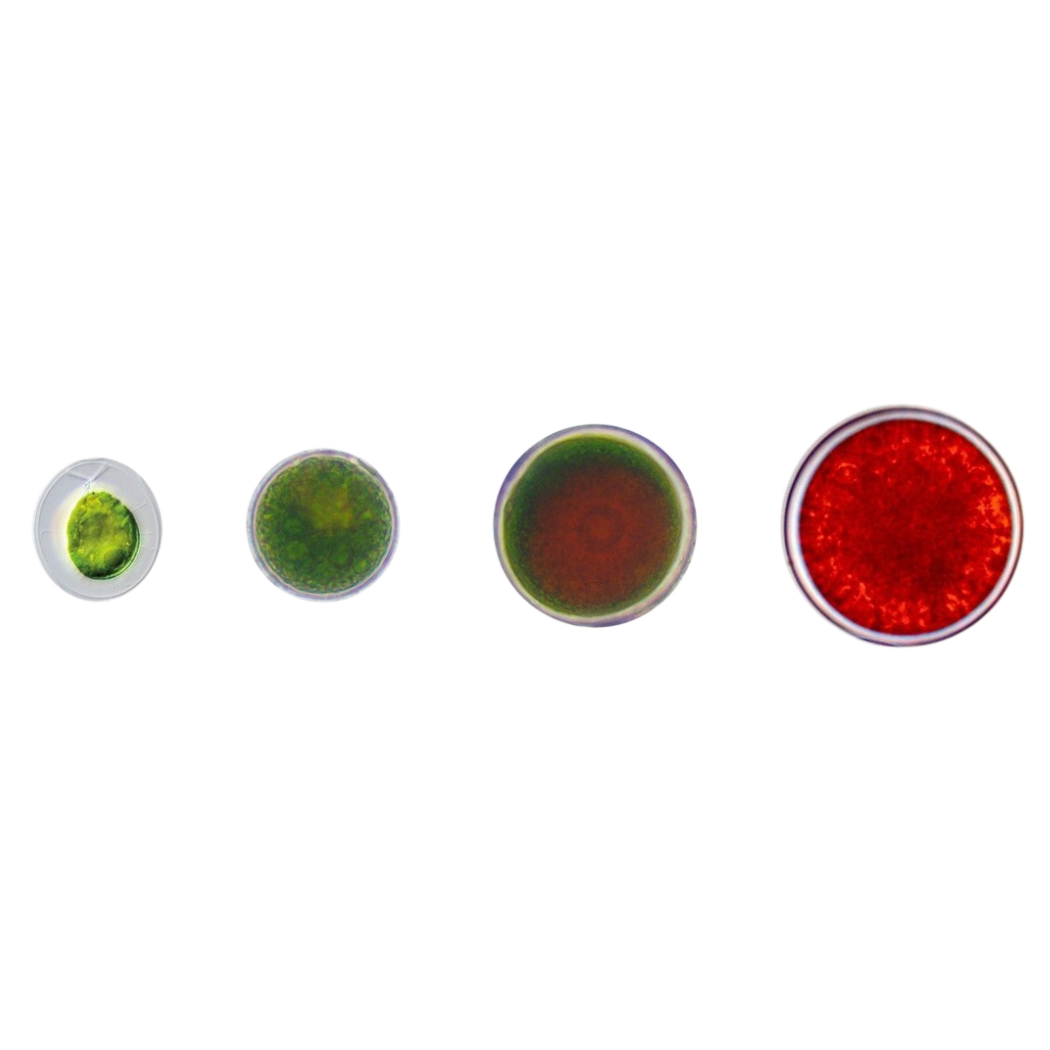
Astaxanthin is a red carotenoid pigment. Its richest natural source is the freshwater microalgae Haematococcus pluvialis. The alga produces astaxanthin to protect itself from intense light and harsh conditions.
Salmon, shrimp and krill get their pink-red colour from astaxanthin in their diet. Krill oil contains small amounts. Haematococcus pluvialis remains the most concentrated natural source by far.
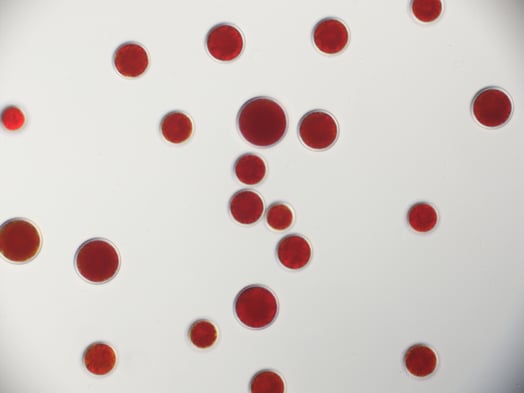
Why astaxanthin works differently from other antioxidants
Most antioxidants work in either the watery or the fatty parts of a cell. Astaxanthin has water-friendly ends and a fat-friendly middle. This shape lets it span the full width of a cell membrane, so it protects the inner and outer layers at once.
In lab tests, astaxanthin quenched singlet oxygen up to 6,000 times more strongly than vitamin C⁹. That result explains why astaxanthin often ranks as the strongest antioxidant found in nature. When you compare astaxanthin vs vitamin C, location matters too. Vitamin C protects the watery parts of a cell, while astaxanthin protects the membranes.
What the research on mitochondria shows
Research on astaxanthin and mitochondria comes mainly from cell and animal studies. The findings point in the same direction.
- In a 2009 study, astaxanthin at very low doses kept mitochondria in a healthy, reduced state under oxidative stress. It also supported membrane potential and cell respiration¹⁰.
- In a 2019 study on muscle cells, astaxanthin reduced free radical production during heat stress. It preserved mitochondrial structure and raised PGC-1α, the main signal for building new mitochondria. Quercetin, another antioxidant tested, did not show this effect¹¹.
- In a 2019 study on heart mitochondria, astaxanthin slowed the opening of the permeability transition pore. This helped the inner membrane stay intact under stress¹².
Together, these results explain why researchers study astaxanthin as a mitochondria-focused antioxidant for mitochondrial health. Astaxanthin fits into a routine that already includes exercise, good sleep and a varied diet.
Astaxanthin also stays stable once it sits in the membrane. In a membrane study, astaxanthin preserved membrane structure and cut lipid damage by 40%. Beta-carotene and lycopene did the opposite and increased damage by more than 85%¹³. For your mitochondria, that means protection without extra oxidative load.
Why astaxanthin quality matters
Astaxanthin is a sensitive molecule. Light, heat and oxygen break it down. A degraded product delivers less active astaxanthin to your cells.
When you look for the strongest antioxidant supplement, check three things.
- Choose natural astaxanthin from Haematococcus pluvialis, not synthetic astaxanthin.
- Look for closed, indoor cultivation, which lowers contamination risk compared with open ponds.
- Check for third-party testing and a clear shelf life.
At axabio®, we grow Haematococcus pluvialis in patented fourth-generation flat-panel photobioreactors in Belgium. The closed system produces a high share of mature red cells. That gives a purer, more stable natural astaxanthin with consistent quality from batch to batch. axabio® is also the first natural astaxanthin producer with B Corp certification.

If you buy in Hungary, Axacell offers natural astaxanthin supplements made with axabio® astaxanthin and produced with these standards in mind. Their guide explains how to choose the best astaxanthin.
Mitochondrial Health Starts With Daily Choices
Your mitochondria make the energy behind every heartbeat, thought and step. With age and oxidative stress, they make less energy and more free radicals, and that cycle speeds up the decline.
Good mitochondrial health comes from steady habits. Move every day, sleep enough, eat a colourful diet and manage stress. Antioxidants that protect cell membranes, such as astaxanthin, add another layer of support.
Want to learn more about natural astaxanthin? Explore the axabio® Knowledge Hub, or contact our team to discuss astaxanthin for your brand.

References
- Törnroth-Horsefield S, Neutze R. Opening and closing the metabolite gate. Proc Natl Acad Sci U S A. 2008;105(50):19565-6. doi:10.1073/pnas.0810654106
- Raichle ME, Gusnard DA. Appraising the brain’s energy budget. Proc Natl Acad Sci U S A. 2002;99(16):10237-9. doi:10.1073/pnas.172399499
- López-Otín C, Blasco MA, Partridge L, Serrano M, Kroemer G. The hallmarks of aging. Cell. 2013;153(6):1194-217. doi:10.1016/j.cell.2013.05.039
- Dai DF, Chiao YA, Marcinek DJ, Szeto HH, Rabinovitch PS. Mitochondrial oxidative stress in aging and healthspan. Longev Healthspan. 2014;3:6. doi:10.1186/2046-2395-3-6
- Robinson MM, Dasari S, Konopka AR, Johnson ML, Manjunatha S, Esponda RR, et al. Enhanced protein translation underlies improved metabolic and physical adaptations to different exercise training modes in young and old humans. Cell Metab. 2017;25(3):581-92. doi:10.1016/j.cmet.2017.02.009
- Xu X, Pang Y, Fan X. Mitochondria in oxidative stress, inflammation and aging: from mechanisms to therapeutic advances. Signal Transduct Target Ther. 2025;10(1):190. doi:10.1038/s41392-025-02253-4
- Bull FC, Al-Ansari SS, Biddle S, Borodulin K, Buman MP, Cardon G, et al. World Health Organization 2020 guidelines on physical activity and sedentary behaviour. Br J Sports Med. 2020;54(24):1451-62. doi:10.1136/bjsports-2020-102955
- Ristow M, Zarse K, Oberbach A, Klöting N, Birringer M, Kiehntopf M, et al. Antioxidants prevent health-promoting effects of physical exercise in humans. Proc Natl Acad Sci U S A. 2009;106(21):8665-70. doi:10.1073/pnas.0903485106
- Nishida Y, Yamashita E, Miki W. Quenching activities of common hydrophilic and lipophilic antioxidants against singlet oxygen using chemiluminescence detection system. Carotenoid Sci. 2007;11:16-20.
- Wolf AM, Asoh S, Hiranuma H, Ohsawa I, Iio K, Satou A, et al. Astaxanthin protects mitochondrial redox state and functional integrity against oxidative stress. J Nutr Biochem. 2010;21(5):381-9. doi:10.1016/j.jnutbio.2009.01.011
- Yu T, Dohl J, Chen Y, Gasier HG, Deuster PA. Astaxanthin but not quercetin preserves mitochondrial integrity and function, ameliorates oxidative stress, and reduces heat-induced skeletal muscle injury. J Cell Physiol. 2019;234(8):13292-302. doi:10.1002/jcp.28006
- Baburina Y, Krestinin R, Odinokova I, Sotnikova L, Kruglov A, Krestinina O. Astaxanthin inhibits mitochondrial permeability transition pore opening in rat heart mitochondria. Antioxidants (Basel). 2019;8(12):576. doi:10.3390/antiox8120576
- McNulty HP, Byun J, Lockwood SF, Jacob RF, Mason RP. Differential effects of carotenoids on lipid peroxidation due to membrane interactions: X-ray diffraction analysis. Biochim Biophys Acta. 2007;1768(1):167-74. doi:10.1016/j.bbamem.2006.09.010
- Brendler T, Williamson EM. Astaxanthin: how much is too much? A safety review. Phytother Res. 2019;33(12):3090-111. doi:10.1002/ptr.6514