

Jonas De Cooman
Jonas is a bioengineer and biotech innovator dedicated to advancing health. As a co-founder of axabio and science enthusiast, Jonas possesses an inherent passion for longevity and is continually exploring the latest advancements in this field, especially those combating inflammation and increasing lifespan.
Natural astaxanthin from Haematococcus pluvialis is one of the most potent natural antioxidants available, with singlet oxygen quenching capacity estimated at 6,000 times that of vitamin C. The global market exceeds $700 million and is projected to surpass $1.5 billion by 2030.
However, product quality varies dramatically depending on production technology.
This guide profiles the top 10 natural astaxanthin producers worldwide, compares each by bioreactor generation, and explains how reactor architecture determines purity, stability, and bioavailability.
What Are the Four Generations of Astaxanthin Production Technology?
Commercial Haematococcus pluvialis cultivation has evolved through four distinct technology generations, each defined by bioreactor geometry and illumination method.
These architectural differences directly determine product quality. We compared the CoA made by independent laboratory and their analysis confirm that heavy metal contamination, molecular stability, potency accuracy, and solvent residues all correlate with production generation¹.
The four generations are:
- Generation 1: Open pond systems (raceway ponds, sunlight-driven)
- Generation 2: Indoor tank-based systems (stainless-steel vessels, LED-lit)
- Generation 3: Tubular photobioreactor systems (glass tubes, outdoor or indoor)
- Generation 4: Flat-panel photobioreactor systems (thin vertical panels, LED-lit, continuous cascade)
Each generation offers specific advantages and trade-offs.
The sections below detail how they work, who uses them, and what the quality data shows.
Who Are the Top 10 Natural Astaxanthin Producers, and What Technology Do They Use?
The table below maps the top and best 10 natural astaxanthin producers in the world along with their primary cultivation technology, based on publicly available production descriptions.
|
Producer |
Country |
Technology |
Generation |
|---|---|---|---|
|
Cyanotech (BioAstin®) |
USA (Hawaii) |
Open ponds |
Generation 1 |
|
Parry Nutraceuticals (E.I.D. Parry) |
India |
Open ponds |
Generation 1 |
|
Atacama Bio Natural Products (NatAxtin®) |
Chile |
Hybrid closed + open raceway ponds |
Generation 1 (hybrid) |
|
AstaReal (Fuji Chemical) |
Sweden / Japan/USA |
Indoor stainless-steel tank bioreactors |
Generation 2 |
|
BDI-BioLife Science |
Austria |
Indoor tank-based systems |
Generation 2 |
|
Algalíf Iceland |
Iceland |
Indoor tubular photobioreactors |
Generation 3 (indoor) |
|
Algatech (Solabia Group) |
Israel |
Outdoor tubular PBRs |
Generation 3 (outdoor) |
|
BGG / AlgaeHealth Sciences |
China |
Outdoor vertical tubular PBRs |
Generation 3 (outdoor) |
|
Algamo (Algastin®) |
Czech Republic |
Indoor tubular photobioreactors |
Generation 3 (indoor) |
|
axabio® |
Belgium |
Indoor cascade flat-panel PBRs |
Generation 4 |
Classification based on publicly available production descriptions and third-party accredited lab testing.
How Do Open Pond Systems (Generation 1) Work?
Open ponds are the simplest and oldest approach to H. pluvialis cultivation: shallow raceway basins (15-30 cm depth) circulated by paddle wheels under natural sunlight.
Culture densities are low, typically 0.5-1.0 g/L¹³.
Advantages: Low capital cost. Simple construction. No electricity for illumination. Long regulatory track record. Large-scale capacity proven over decades.
Trade-offs: Direct atmospheric exposure creates contamination pathways. Independent testing found that 100% of open-pond samples contained heavy metal contamination, with arsenic averaging 0.34 mg/kg¹. Potency shortfalls averaged 16.9% versus label claims¹.
Residual solvents were detected in 50% of samples (toluene at 6.81 mg/kg, hexanal at 127 mg/kg in one sample)¹. Water consumption is high due to evaporation and low culture density⁴ ²².
Who uses Generation 1 technology?
-
Cyanotech Corporation (Kailua-Kona, Hawaii, USA) has cultivated H. pluvialis in open ponds since the late 1980s, making it one of the longest-established natural astaxanthin producers in the world. Their BioAstin® brand holds FDA GRAS status and benefits from Hawaii's consistent sunlight and clean ocean air. Cyanotech's location and brand recognition have earned it a loyal consumer base in the supplement market.
-
Parry Nutraceuticals / E.I.D. Parry (Chennai, India), part of the Murugappa Group, operates large-scale cultivation facilities in southern India. Their AstaREG® brand serves both nutraceutical and aquaculture markets, competing effectively on price for high-volume applications.
-
Atacama Bio Natural Products (Iquique, Atacama Desert, Chile) has produced natural astaxanthin since 2003, using a proprietary hybrid approach: initial cell growth takes place in enclosed photobioreactors, followed by astaxanthin induction in open raceway ponds under the intense natural sunlight of the Atacama Desert, the highest solar irradiance on Earth. The company uses pure underground water from the Andes Mountains and HEPA-filtered air for the enclosed growth phase. Their NatAxtin® brand is NAXA-verified and distributed across Europe, Asia, and North America. Atacama Bio positions its process as "biomimicry" , allowing H. pluvialis to complete its natural stress cycle under real sunlight rather than artificial LEDs. This approach minimises energy consumption but, like all outdoor systems, remains subject to the contamination and variability trade-offs inherent to open-air cultivation.
How Do Indoor Tank Systems (Generation 2) Work?
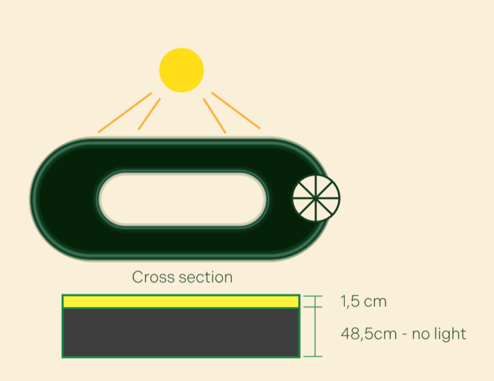
Generation 2 systems use large stainless-steel cylindrical tanks operated entirely indoors with LED illumination. Cultures are grown in batch mode, transferred between progressively larger vessels, and stressed under high-intensity light.
Culture densities reach 4-6 g/L⁴.
Advantages: Complete indoor containment eliminates atmospheric contamination. HEPA-filtered air and triple-filtered water create pharmaceutical-grade conditions. Year-round, weather-independent production. Solvent-free supercritical CO₂ extraction.
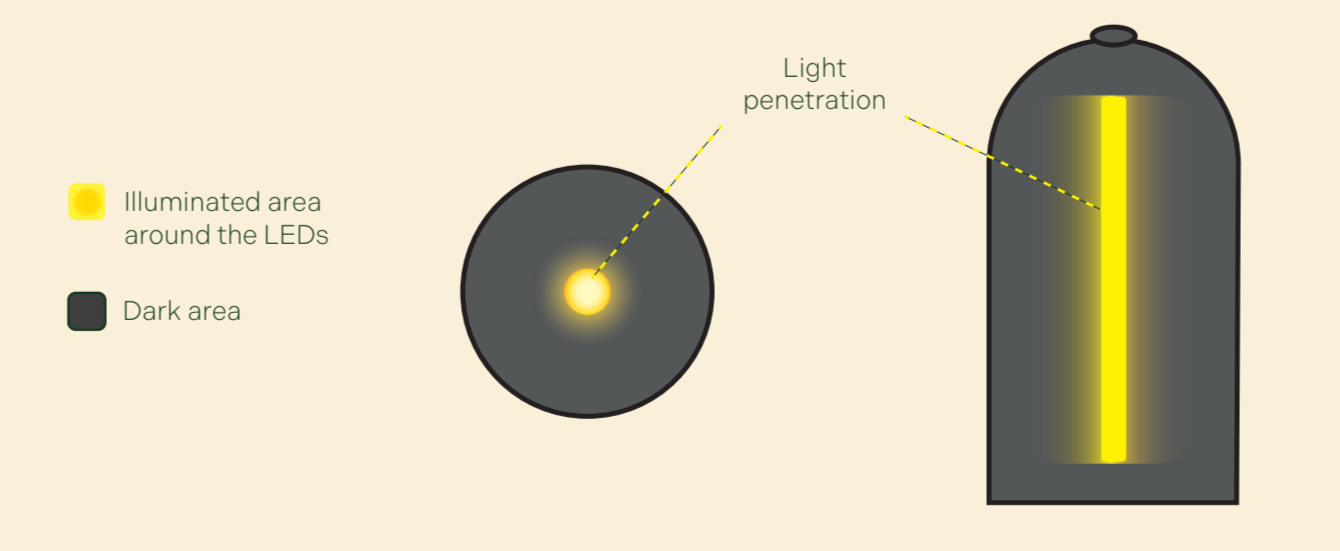
Trade-offs: Tank geometry creates significant light gradients, cells near LEDs receive excessive irradiance while distant cells remain light-limited, producing heterogeneous maturation⁴.
Third-party data shows the highest cis/trans ratio of any generation (0.401), indicating molecular degradation from processing stress¹. Average potency under-delivery reached 21.2%, one of the worst of all generations¹.
Who uses Generation 2 technology?
-
AstaReal, part of Fuji Chemical Industries (Gustavsberg, Sweden and Moses Lake, Washington, USA) is the global market leader in natural astaxanthin and a genuine industry pioneer. AstaReal traces its origins to research at Uppsala University in the early 1990s and launched the world's first commercial natural astaxanthin supplement in 1995. The company has accumulated over 80 human clinical studies on its astaxanthin by far the most extensive clinical evidence base in the industry. AstaReal's products hold USP Verified status and are manufactured to pharmaceutical-grade standards across two production sites, providing supply redundancy. While tank-based geometry presents inherent light distribution constraints, AstaReal's clinical credibility, quality control, and brand authority set an industry benchmark that every other producer is measured against.
-
BDI-BioLife Science (Hartberg, Austria), a subsidiary of BDI-BioEnergy International, produces natural astaxanthin using indoor tank-based fermentation systems developed in-house. BDI-BioLife positions itself as a leading natural astaxanthin producer in Central Europe, with a production infrastructure designed for year-round availability and consistent quality. The company's engineering heritage in industrial plant construction and process technology provides deep process control expertise. BDI-BioLife serves food supplement, cosmetic, and pharmaceutical markets across Europe.
How Do Tubular Photobioreactors (Generation 3) Work?
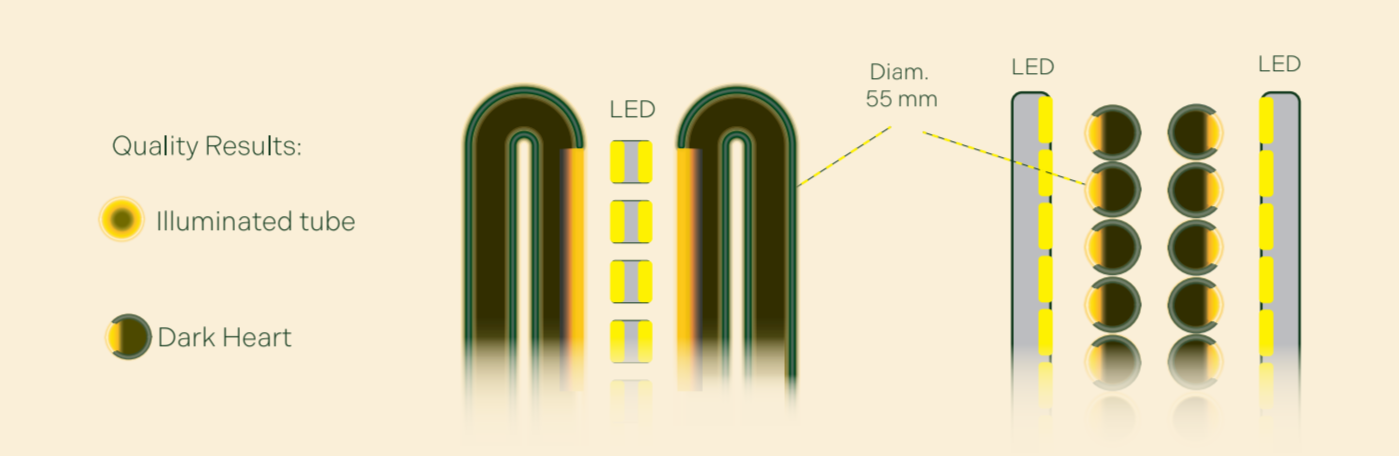
Tubular systems use transparent borosilicate glass or plastic tubes (50-60 mm diameter) in serpentine or vertical configurations. Light is provided by sunlight (outdoor) or external LEDs (indoor). Culture is pumped through the tube network¹⁶.
Advantages: Better light-path control than tank systems. Closed-system design reduces contamination versus open ponds. Modular and scalable. Outdoor variants save electricity by using sunlight.
Trade-offs vary between outdoor and indoor variants:
-
Outdoor tubular systems: 100% of tested samples contained residual solvents (toluene averaging 0.95 mg/kg). 33% showed ethanol at 905 mg/kg, suggesting solvent extraction despite supercritical CO₂ claims¹. Arsenic contamination reached 0.425 mg/kg in one sample¹.
-
Indoor tubular systems: Diester/monoester ratio of 0.40, the lowest of any closed system, indicates the least stable esterification profile among premium indoor producers¹. Average potency under-delivery of 4.5%¹. 50% of samples showed heavy metal contamination¹.
Who uses Generation 3 technology?
-
Algatech, part of Solabia Group (Ketura, Arava Desert, Israel) operates one of the world's largest closed tubular photobioreactor installations with over 600 km of glass tubes in the Negev desert. Algatech harnesses extreme desert conditions (intense sunlight, large temperature differentials) as natural stress inducers. Their AstaPure® brand is positioned strongly in clean-label markets with organic, kosher, and halal certifications. Acquired by Solabia Group in 2022, Algatech has established scalable outdoor production, though outdoor operation introduces the contamination and variability trade-offs inherent to all open-air systems.
-
BGG / AlgaeHealth Sciences (Kunming, Yunnan Province, China) operates an 80-acre facility with vertical tubular photobioreactors, producing an estimated 2+ tonnes of astaxanthin annually. Their AstaZine® brand holds a strong position in Asian markets, and the facility represents one of the largest natural astaxanthin production capacities in the world.
-
Algamo (Mostek, Czech Republic) is a European producer established in 2011, cultivating H. pluvialis in fully enclosed indoor tubular photobioreactors located in the Krkonoše Mountains National Park. Algamo is notable for being the only astaxanthin producer in the world certified under the EU Organic label for its entire production process. Here it is important to remind the reader that for the EU Bio certification, every country decides on how to translate the EU regulation into their own regulation - concretely, not all EU bio label are equals and a lot depend on how far the country went when translating the EU regulation. The company uses its own mountain spring water source and renewable energy from a local biomass power plant, underscoring a strong environmental commitment. Their Algastin® brand supplies cosmetic, and dietary supplement markets. As the only natural astaxanthin producer in Central Europe, Algamo has established a distinctive positioning around organic certification and environmental purity.
-
Algalíf (Reykjanesbær, Iceland) operates indoor tubular photobioreactors that leverage Iceland's abundant geothermal energy and pure glacial water sources. The company focuses on high-quality astaxanthin production with a strong sustainability narrative, using renewable energy for its entire operation. Algalíf's ASTALIF™ brand is recognised for its potent antioxidant properties and is supported by clinical data. Iceland's unique natural resources such as clean water, renewable geothermal energy, and a pristine environment provide Algalíf with a compelling sustainability positioning within the Generation 3 segment.
How Do Flat-Panel Photobioreactors (Generation 4) Work?
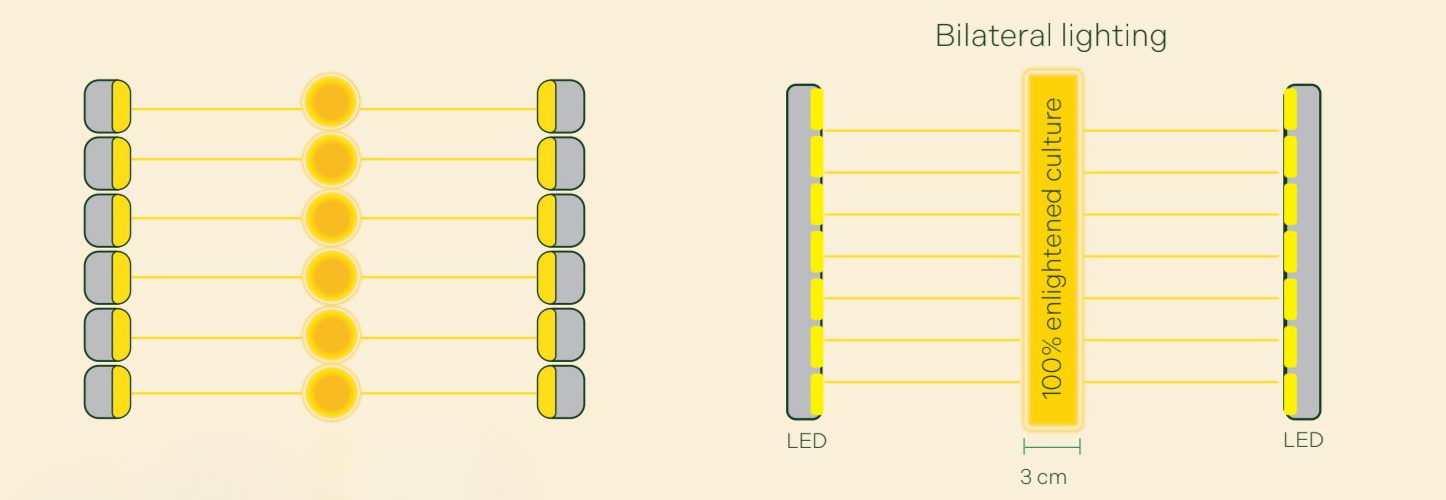
Generation 4 flat-panel systems use thin vertical panels (2-2.5 cm culture depth) with external LED illumination, creating a short optical path that minimises light attenuation. Its operational densities is substantially higher than any previous generation as virtually all cells receive adequate photosynthetically active radiation, enabling synchronous maturation¹⁷ ¹⁸.
The defining innovation is continuous cascade operation: green vegetative culture flows continuously into downstream stress-induction panels without batch interruptions, dilution steps, or transfer losses. This eliminates downtime and maximises productivity¹⁹.
Advantages:
- 2-3× higher photon utilisation efficiency than tubular or tank geometries¹⁷ ¹⁸
- All heavy metals (As, Cd, Hg, Pb, Cr, Se) below the limit of quantification¹
- Industry-best cis/trans ratio: 0.223 (44% better than worst-performing generation)¹
- Diester/monoester ratio: 0.54, confirming stable esterification¹
- Potency: +1.0% over-delivery versus label¹
- Energy: 37% lower than next-best indoor competitor²⁰ ²¹
- 90% operational uptime through continuous flow⁵
Trade-offs: Higher capital expenditure per unit capacity. Engineering complexity of continuous cascade operation.
Who uses Generation 4 technology?
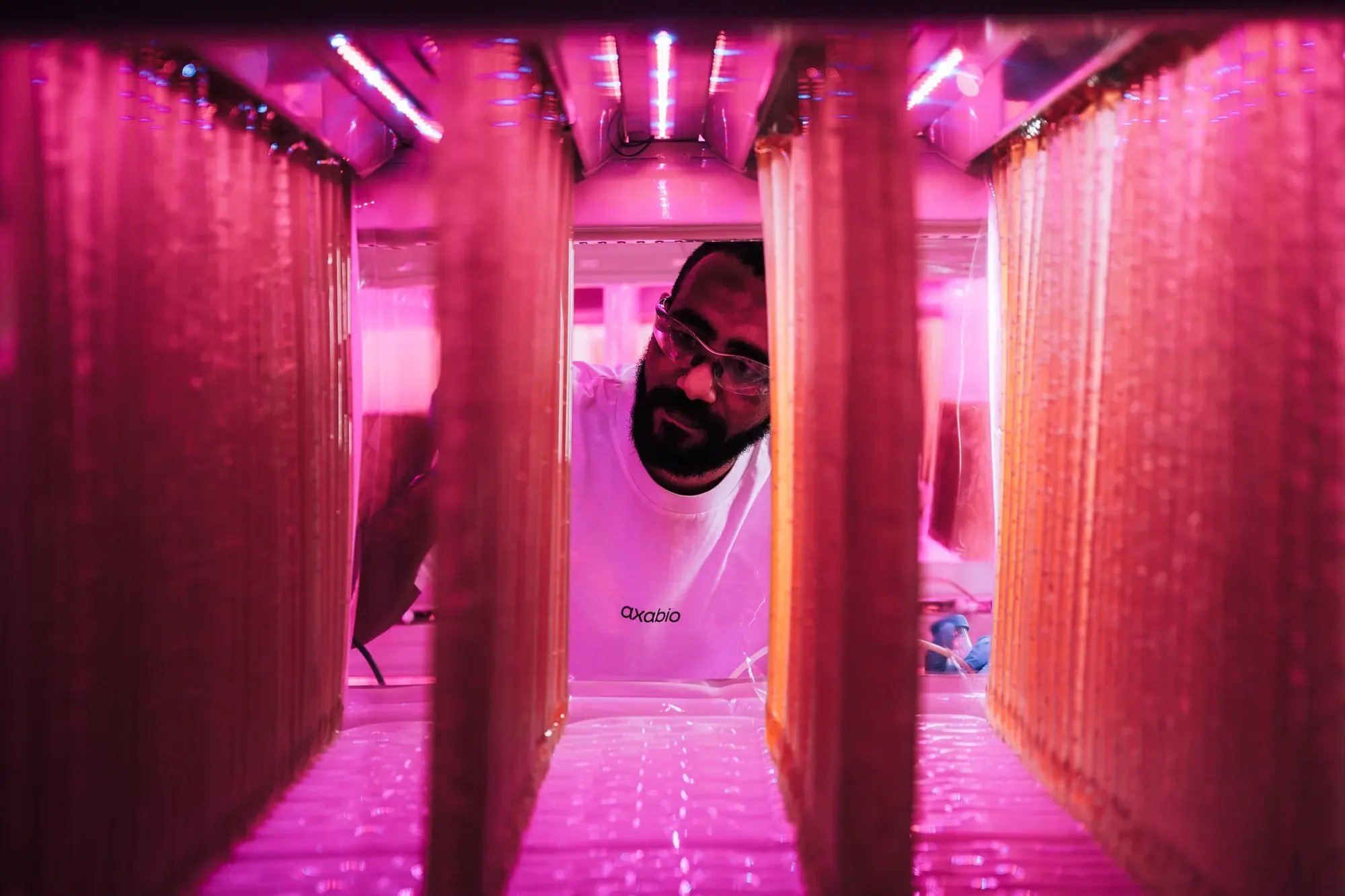
axabio®(Hemiksem, Belgium) is a Belgian biotechnology company that spun off from Proviron in 2024 to focus exclusively on premium natural astaxanthin production. axabio operates a fourth-generation cascade flat-panel photobioreactor system developed through more than a decade of engineering R&D, with patent protection (EP2039753A1 and EP2203546B1).
axabio® is a team with a clear focus: produce the highest-quality natural astaxanthin achievable through technology, with full transparency on process and product data. All quality claims are verified by independent third-party laboratory analyses. The company openly publishes comparative data because it believes an informed market benefits all participants.
axabio® partners with UGent and UAntwerp for ongoing research, Nateco₂ for supercritical CO₂ extraction, and Kunnig (a Belgian social enterprise) for downstream processing. The production facility runs on certified renewable energy, and axabio was certified as a B Corporation™ in 2026 with a B Impact Score of 108.5, with its strongest recognition in the Environment category.
How Does Astaxanthin Quality Compare Across Generations?
The following data consolidates independent third-party laboratory analyses¹ and published life-cycle assessment literature⁴ ²⁰ ²². These metrics provide a quantitative framework for evaluating astaxanthin source materials.
|
Quality Parameter |
Gen. 1: Open Ponds |
Gen. 2: Tank Systems |
Gen. 3: Tubular PBRs |
Gen. 4: Flat-Panel PBRs |
|---|---|---|---|---|
|
Potency vs label |
-16.9% |
-21.2% |
+6.5% / -4.5% |
+1.0% |
|
Heavy metal contamination |
100% of samples |
100% of samples |
33-50% |
All < LOQ |
|
Cis/trans ratio (lower = better) |
0.272 |
0.401 |
0.274-0.313 |
0.223 |
|
Diester/monoester ratio |
0.60 |
0.49 |
0.40-0.65 |
0.54 |
|
Residual solvents |
50% contaminated |
Not detected |
100% (outdoor) |
Not detected |
Sources: Third-party laboratory analyses¹, published LCA literature⁴ ²⁰ ²².
What Does the Cis/Trans Ratio Mean for Astaxanthin Quality?
The cis/trans ratio measures how much astaxanthin has been converted from the biologically active trans-configuration to the less stable cis form during processing. Heat, mechanical shear, and harsh extraction cause this degradation. A lower ratio means gentler processing and better molecular preservation. The 44% differential between Generation 4 (0.223) and Generation 2 (0.401) demonstrates that production technology has a measurable impact on molecular quality¹ ⁶ ⁸.
What Is the Diester/Monoester Ratio?
In mature Haematococcus pluvialis aplanospores, astaxanthin is esterified with fatty acids: first as monoesters, then as diesters as cells complete their natural maturation cycle. A balanced diester/monoester ratio indicates that cells were harvested at optimal maturity, and this ratio is one of the most reliable markers of astaxanthin quality and bioavailability that buyers and formulators should look for.
Why a high diester ratio matters: Fully esterified astaxanthin (the diester form) is significantly more stable and more efficiently absorbed by the body than its less-mature counterparts. Diesters resist oxidative degradation during shelf storage, preserve the active trans-isomer configuration, and deliver a consistent dose-response relationship, meaning the potency stated on the label is the potency the consumer actually receives. A low diester ratio, by contrast, signals incomplete cellular maturation: the astaxanthin is poorly esterified, molecularly fragile, and less bioavailable.
The production data across generations makes this concrete. Generation 3 tubular photobioreactors despite being a closed, controlled system yield the lowest diester ratio of any indoor technology (0.40), precisely because their 55 mm tube diameter creates a dark core that prevents uniform light penetration, leaving a large proportion of cells incompletely stressed. Generation 2 fermentation tanks perform only marginally better (diester ratio: 0.49), again due to heterogeneous light exposure. Generation 4 flat-panel photobioreactors, by contrast, achieve a diester ratio of 0.54, which is the optimal balance for indoor production, by exposing 100% of the culture to uniform bilateral light, driving synchronized full-cell maturation across every batch.
Systems producing heterogeneous cell populations, a mix of green, transitional, and fully red cells, yield lower diester ratios, reflecting incomplete maturation, reduced molecular stability, and compromised astaxanthin bioavailability⁹ ¹¹. In short, reactor technology directly determines light penetration, light penetration determines cell maturity, and cell maturity determines the diester ratio your product delivers.
Why Do Heavy Metals Accumulate Differently Across Generations?
H. pluvialis bio-accumulates trace metals from cultivation water². Total exposure correlates with water volume per kilogram of biomass. Open ponds at 0.5-1.0 g/L require 60-70× more water contact per kilogram than Generation 4 systems operating at 8-10 g/L⁴ ¹¹ ²².
This density differential, combined with atmospheric exposure in outdoor systems, explains the contamination patterns across generations.
How Should You Choose an Astaxanthin Supplier?
Selecting the right astaxanthin source depends on your specific priorities:
If clinical evidence depth is your priority: AstaReal's Generation 2 technology offers over 80 human clinical studies and USP Verified status as the deepest scientific dossier in the industry.
If EU Organic certification matters most: Algamo is currently the only astaxanthin producer certified EU Organic for its entire process, with production powered by renewable energy in a national park environment.
If price and volume drive your decision: Generation 1 open-pond producers like Cyanotech and Parry Nutraceuticals offer competitive pricing and established, high-capacity supply chains.
If you need large-scale closed-system supply: Generation 3 producers like Algatech (Israel) and BGG (China) operate at meaningful scale with strong certification portfolios.
If maximum purity, stability, and sustainability are decisive: Generation 4 flat-panel technology from axabio® (Belgium) delivers best-in-class results across all measurable quality parameters, verified by independent laboratory data.
References
- axabio® (2025). Bioreactor Generations Linked to Product Quality. Third-party laboratory analysis comparing astaxanthin quality across production systems. Internal technical report with independently verified data.
- Chekroun, K.B., Sánchez, E., & Baghour, M. (2013). The role of algae in bioremediation of organic pollutants. International Research Journal of Public and Environmental Health, 1(2), 19–32.
- Onorato, C., & Rösch, C. (2020). Comparative life cycle assessment of astaxanthin production with Haematococcus pluvialis in different photobioreactor technologies. Algal Research, 50, 102005.
- Quinn, J.C., et al. (2012). Nannochloropsis production metrics in a scalable outdoor photobioreactor for commercial applications. Bioresource Technology, 117, 164–171.
- Boussiba, S. (2000). Carotenogenesis in the green alga Haematococcus pluvialis: Cellular physiology and stress response. Physiologia Plantarum, 108(2), 111–117.
- Shah, M.M.R., et al. (2016). Astaxanthin-producing green microalga Haematococcus pluvialis: from single cell to high value commercial products. Frontiers in Plant Science, 7, 531.
- Hagen, C., et al. (2002). Functional aspects of secondary carotenoids in Haematococcus pluvialis. Journal of Phycology, 38(5), 793–799.
- Ranga Rao, A., et al. (2013). Characterisation of microalgal carotenoids by mass spectrometry and their bioavailability and antioxidant properties elucidated in rat model. Journal of Agricultural and Food Chemistry, 61(31), 7543–7595.
- axabio® (2025). Bioreactor Generations Linked to Product Quality. Internal technical report.
- Borowitzka, M.A. (1999). Commercial production of microalgae: ponds, tanks, tubes and fermenters. Journal of Biotechnology, 70(1–3), 313–321.
- Singh, R.N. & Sharma, S. (2012). Development of suitable photobioreactor for algae production. Renewable and Sustainable Energy Reviews, 16(4), 2347–2353.
- Hu, Q., Guterman, H., & Richmond, A. (1996). A flat inclined modular photobioreactor for outdoor mass cultivation of photoautotrophs. Biotechnology and Bioengineering, 51(1), 51–60.
- Richmond, A. & Cheng-Wu, Z. (2001). Optimisation of a flat plate glass reactor for mass production of Nannochloropsis sp. outdoors. Journal of Biotechnology, 85(3), 259–269.
- axabio® (2025). Continuous cascade flat-panel photobioreactor operation. Internal process documentation.
- axabio® (2025). Energy Efficiency Benchmarking of axabio's Cascade Flat-Panel System vs. Industry Standard. Internal report.
- axabio® (2025). Energy Efficiency in Premium Astaxanthin Production: Competitive Benchmarking and Strategic Positioning.
- axabio® (2025). Water Efficiency and Recycling Technology in High-Density Astaxanthin Production.
- EFSA Panel on Dietetic Products, Nutrition and Allergies (2014). Scientific Opinion on the safety of astaxanthin-rich ingredients. EFSA Journal, 12(7), 3757.
Published by axabio®, a Belgian biotechnology company producing natural astaxanthin from Haematococcus pluvialis using patented fourth-generation flat-panel photobioreactor technology. axabio is a certified B Corporation™. Contact: info@axabio.be | www.axabio.be
Technology generation classifications are based on publicly available production descriptions. Quality data from third-party laboratory analyses (ref. 1) were conducted on commercially available products representing each generation. This article was last updated in April 2026.